Much Ado About Decolonization

Female Nok Head from the ancient Nok Civilization in Modern Day Kaduna State, Northwestern Nigeria

I have lived in Europe for a little over a year now. The experience has felt like a personal social experiment to find a place in the world I belong outside of my ‘natural habitat’ and the lands of my ancestors in the far northwestern state of Kaduna, Nigeria. 

As I settle into these Western worlds and attempt to create for myself a place in it, I am continually jarred by what I can only describe as a prevailing disconnection between the human and their soul. This is not necessarily a new phenomenon that I have observed. The case is also largely true for many people in the country I come from. In Nigeria, I met, loved, cared for, and even worked with people whose detachment from their spirits was glaring in how they treated themselves and responded to the world around them. 

Having lived here now for a over year, I am observing that the major difference between the human-soul separation in the West and my ancestral lands is the fact that this separation from spirit has gone on for much longer and has thus happened so extensively that it feels almost hopeless that there may be redemption for the populations in these parts of the world. 

In my home country, I see that this separation is happening quite gradually and it makes me fear for the future of my country, and the people I love who are still there. It makes me wonder if there will ever be a safe way back home, to the heart and soul of what it originally meant to know ourselves and perceive each other as powerful spirits who have incarnated here on Earth for a collective human experience. 

A buzzword I have come to have a love-hate relationship with is “decolonization.” Everybody and their grandmama wants to decolonize something. I am not even going to play innocent, I have been on the decolonization bandwagon for years now and this is evident in at least three well-funded projects I have been a part of. What has however remained a jarring experience is that many people I have come across who are on this decolonization train, that is headed only god knows where, are still very much colonized in their thinking and how they relate to the world around them. 

Now, I will be the first to make excuses for people because most of us alive today have been socialized in a colonized world. Many of us know nothing of a world before colonization and that is not necessarily of our own making. However, after being a part of the conversation now for some time, and having questioned my intentions, beliefs, and actions, I have come to see that decolonization is nothing more than a buzzword that gets people and institutions a certain kind of attention and access when they need it. Worse, the actions of many agents and institutions that seem to center this idea of decolonization are, in fact, a sort of neo-colonization of already colonized populations and cultures. 

This is dangerous territory because these people and institutions are only interested in specific aspects of the culture and lives of already subjugated people that fit a certain narrative and agenda. These folks are not interested in the sovereignty of previously colonized cultures or even restoring colonized peoples and cultures to their former glory. For them, ‘decolonization’ is a cool word to throw around to show that they are aware of the evils of colonialism, and possibly that they also believe in the autonomy of the colonized. However, when one attempts to engage deeper in the discourse on decolonization, beyond the niche area that has been chosen as the main lens through which we can engage in the discourse, one begins to find various gaps in the knowledge, understanding, and even interest of what it truly means to decolonize.

As a spiritual practitioner and a person who leads and lives spirit-first, quite like my pre-colonial ancestors did, I have come to find the discourse on decolonization to be shallow, lacking in spirit and thus substance. Furthermore, this emphasis on decolonizing still centers the ‘colonial’, and that simply rubs me the wrong way. 

I love a good inquiry, questions have led me down the path of many a life-changing realization and revelation. So, my question to everyone, and no one at all, is this: 

When you use the word ‘decolonize’ what are you attempting to say or do? 

Do your ‘decolonization’ efforts only begin and end when a project is proposed, planned, and implemented, or are you working also on decolonizing your mind, beliefs, and the structural systems that prevail?

I simply am unable to see beyond the fact that this word continues to center a system of oppression many of us claim we do not want. I wonder what alternative words and nomenclature exist for our collective and individual efforts to return to a place before the horrors of colonialism separated us from our individual and collective human spirits.

Speaking of spirits, people want to talk about decolonization and yet are deathly afraid of admitting that they are spirit beings having a human experience. There is no Indigenous culture on Earth that does not allude to humans having a spirit or the fact that we are, by existing, in a relationship with a higher realm beyond this physical and material existence. Yet, I continue to meet people who want to decolonize the world and cannot even fathom this crucial aspect of Indigenous life. 

It makes me wonder, if we cannot understand and reconcile this crucial separation that has happened between spirit and matter, what exactly are we then trying to decolonize? If these so-called decolonial efforts are not leading back to a union between spirit and matter, what exactly are we fighting for?

It is laughable at best, and at worst, we are witnessing the coopting of Indigenous knowledge and wisdom in a similar way that colonizers took land, resources, and anything else of value they could lay their hands on after they encountered Indigenous folks. The people and institutions pushing for decolonization without first doing an internal soul-search of how their actions and systems maintain a colonized structure are simply paying lip service and are thus not different from the colonizers who pillaged Indigenous cultures.

The way I see it, this is what it comes down to: are we truly interested in restoring Indigenous systems where people lived in communion with the Great Spirit, the Earth, and each other, or are we simply interested in surviving and getting by in these post and neo-colonial worlds?
Animism: Exploring the Ancient Belief System Connecting Humans and Nature

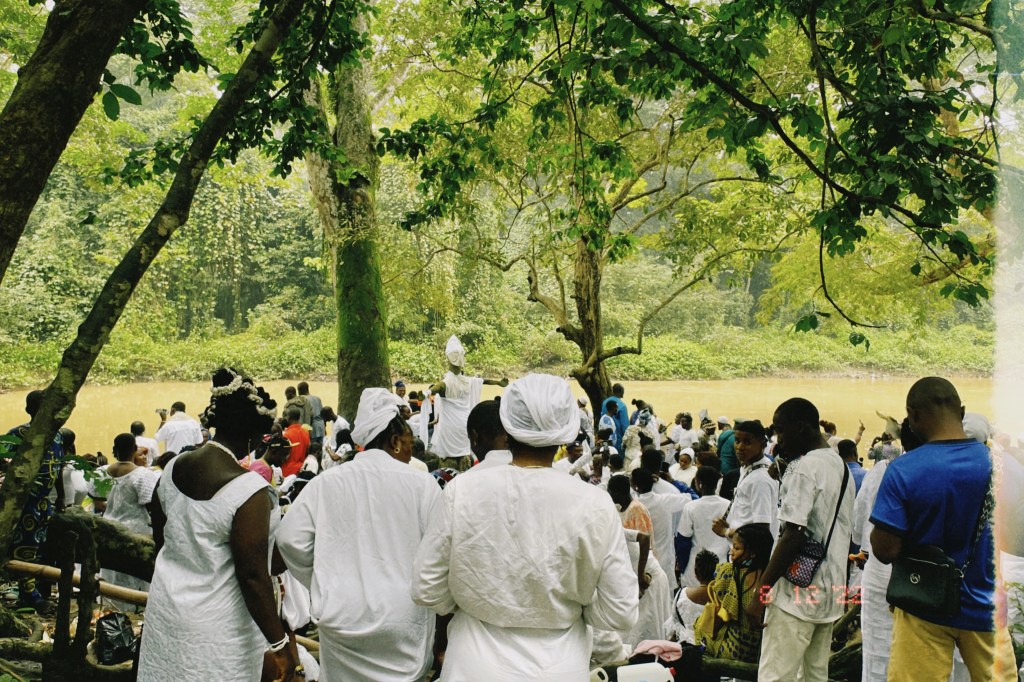
Devotees at the Osun-Osogbo Festival, Osun State, Credit: Oyefeso, Folu

Animism, among humanity’s oldest philosophical and spiritual belief systems, continues to play a vital role in the cultural and spiritual lives of numerous indigenous communities worldwide. Central to animism is the conviction that all elements of the natural world—trees, mountains, rivers, and more—possess a distinct spiritual essence. Far from being confined to a specific region or era, animism has influenced a wide array of civilizations across different geographies and historical periods.

This article explores the multifaceted nature of animism, tracing its origins, foundational principles, and ongoing relevance in contemporary society. By examining animism’s historical and cultural context, we aim to present a concise yet comprehensive overview of this enduring worldview. Our analysis highlights animism’s contemporary importance, including its influence on spiritual practices, environmental ethics, and evolving cultural traditions worldwide.

Historical Roots of Animism

The etymology of the term “animism” can be traced back to the Latin word “anima,” which translates to “soul” or “life force.” However, the underlying idea predates the term and has its roots in the ancient cultures of prehistoric societies. Animism emerged as a means for early societies to comprehend the world and forge a relationship with the natural environment. The Paleolithic era offers evidence of animistic practices, as seen in cave paintings and artifacts, which suggest a profound reverence for animals, plants, and celestial bodies.

At the core of animistic philosophy lies the belief that all entities, regardless of form, possess a spiritual essence. This essence is not limited to humans, but also animates animals, plants, rivers, mountains, and even inanimate objects such as rocks and tools. Moreover, animists perceive the natural world as intrinsically interconnected and interdependent, underscoring a complex web of relationships among all beings. This worldview inspires reverence, respect, and a profound sense of responsibility toward nature. Animistic traditions frequently incorporate elaborate rituals and ceremonies intended to sustain this delicate balance and promote harmony between humans and the natural environment.

Notably, animism has served as a significant cultural force throughout human history and continues to inform the worldview of many indigenous societies. Its emphasis on the spiritual dimension of existence and the interconnectedness of all things resonates with those seeking a deeper and more meaningful relationship with the world.

Illustrative Cases of Animism

Although animism does not adhere to a single cultural tradition, its presence can be identified wherever indigenous peoples have lived. In northern Nigeria, for instance, the indigenous pre-Islamic inhabitants of what is now Kano practiced animism. They worshipped a supreme being, venerated spirits, and offered sacrifices beneath a sacred tree known as Shamuz (or Shamus in some records). Only the high priest, Barbushe, was permitted to approach the Shamuz shrine and conduct sacrifices on behalf of the community. Similarly, the Mawri of Dogondoutchi in Niger believe that humans were separated by the creator from their spirit siblings and are required to appease these spirit siblings to maintain a balanced life.

The presence of elemental deities and spirits associated with various facets of nature attests to the extensive reach of animistic beliefs among prehistoric cultures. The Earth was frequently regarded as the domain of fertility goddesses, such as Uwargona in Hausa tradition, Ala in the Igbo pantheon, and Assase Ya among the Akan. Likewise, the reverence for water spirits—for instance, the goddess Osun in Yoruba tradition—underscores the enduring and profound connection to elemental forces within animistic societies.

Contemporary Relevance of Animism

Anthropologists have observed a renewed interest in animism, often termed “new animism.” This contemporary movement centers on fostering respectful relationships with all beings, both human and non-human—including spirits and entities believed to exist beyond ordinary perception. New animism encourages environmental awareness and draws attention to the widening disconnect between humanity and the natural world. As ecological crises become more acute, this perspective is poised to exert significant influence, promoting stewardship, sustainability, and holistic approaches to planetary well-being.

It is crucial to recognize that, despite the term “new animism,” these beliefs are anything but new. Animistic worldviews and relationships with nature have been foundational for indigenous peoples across history—though they were often denigrated and suppressed by colonial, missionary, and jihadist forces, especially in Africa. Across cultures, animists have cultivated a profound respect for the natural world, recognizing the intrinsic value and agency of all living beings.

Embracing animist principles offers a compelling framework for confronting ecological challenges. It is essential, however, to recognize that animism is a holistic worldview grounded in the spiritual interconnectedness of all beings, and should not be viewed merely as a tool for utilitarian or extractive purposes. Adopting animistic perspectives enables individuals to deepen their awareness of the interdependence of all life forms, thereby fostering more sustainable and harmonious relationships with the environment. Meaningful engagement with animism requires respect, cultural sensitivity, and an informed appreciation of its significance and its potential to advance environmental stewardship.

Image Credit: Oyefeso, F. (2022, September 11). The Osun-Osogbo Festival, Osun State. https://www.foluoyefeso.com/post/the-osun-osogbo-festival-osun-state

Spirits and Deities: Exploring the Distinctions in Supernatural Beings

The belief in supernatural beings is a common thread that ties diverse cultures and spiritual traditions among indigenous people. Spirits and deities are two distinct categories of supernatural beings, each with various characteristics and roles within belief systems. This article will explore the differences between spirits and deities, examining their nature, attributes, and the various cultural contexts in which they are revered.

Spirits are often considered less powerful than deities and may be associated with specific places, objects, or events. Deities are often considered more powerful and may be associated with wider aspects of the natural world or human experience. The nature of spirits and deities can vary greatly from culture to culture. In some cultures, spirits may be considered benevolent, while in others, they may be malevolent. Deities may also be considered benevolent, malevolent, or a mix of both.

Deities: Divine Beings of Power and Worship

Spirits are ethereal beings that occupy an intermediary position between the human and divine realms. In indigenous belief systems, spirits are often associated with specific locations, natural elements, or ancestors. They possess individual identities, consciousness, and agency, yet many spirits lack the grandeur and worship typically accorded to deities, which are a different kind of spirit.

John Mbiti has famously categorized spirits into two groups: those created as spirits and those once human beings. Among those created as spirits are divinities or deities, also known as “those who are associates of God”. Divinities—deities from here—often refer to spirits who are personifications of a supreme being’s activities and manifestations of natural phenomena and objects. Examples of these beings include nature (elemental) spirits, deified heroes, and mythological figures.

Deities are supernatural entities regarded as powerful and transcendent beings embodying various divine aspects. They typically possess elevated status and supreme powers and are revered through worship, rituals, and other religious practices. The Yoruba belief system, for example, recognizes over a thousand deities, Orisa—the most extensively recorded of any African belief system. The Orisa are associated with various aspects of nature, human life and experiences. They are revered as direct messengers who are also often described as an aspect of the supreme itself governing specific domains or spheres, such as love, fertility, war, iron, and wisdom.

Deities are often depicted in human form, but they may also be represented by animals, plants, or other objects. They may be benevolent or malevolent, and they may be invoked for help or protection. Deities play an important role in many cultures and religions, and they continue to be a source of fascination and inspiration for people worldwide.

Non-Deific Spirits

In addition to deities, there are also ordinary spirits, or “spiritual beings who are beneath the status of divinities and above the status of men” (Mbiti, 1970). The origin of spirits varies by spiritual belief system. For example, the Mawri in Dogondoutchi, Niger, believe that spirits are the invisible siblings of humans who were condemned to remain unseen as punishment by the supreme being for the sins of their parents, the first man and woman. In this narrative, and others similar to it, spirits are considered contemporaries of humans because they exist in the same plane as humans, with the most obvious difference being that humans cannot perceive them with their sense of sight.

Perhaps the most commonly recognized spirits are those of deceased humans whom their living relatives often venerate. Beliefs about what happens to our spirits after they depart the human body vary from culture to culture. However, formerly embodied spirits are widely recognized within African spiritual systems. A previous post discussing what happens when we die established that the supernatural plane, where formerly embodied spirits reside, is regarded as an integral part of the material world. As such, in every aspect of our human existence, transitioned spirits “are not merely invoked and observed; their participation and benediction are also requested” (Okwu, 1979). Invoking formerly embodied spirits for their participation and benediction constitutes ancestral veneration.

One key distinction of spirits is their accessibility to human interactions. They are considered approachable, often mediating between humans and higher supernatural powers. Spirits can be invoked, propitiated, and engaged through various rituals, offerings, or acts of reverence.

Key Differences between Spirits and Deities:

The main differences between deities and non-deific spirits can be seen in their power, status, modes of veneration, domains of influence, and transcendence. Deities are often considered more powerful and hold higher status than non-deific spirits. They are worshipped on a grander scale and are associated with broader cosmic functions and mythologies. Deities often receive “formal” veneration through organized practices, such as rituals and ceremonies. 

On the other hand, non-deific spirits may be venerated through more informal means, such as offerings or prayers. Deities are typically associated with specific domains and spheres of influence, such as nature, love, war, or wisdom. Non-deific spirits often have a narrower focus and are connected to ancestral lineages within familial clans and groups.

Deities are often perceived as being transcendent, transcending beyond the human realm. Non-deific spirits are more immanent, tied to specific locations or natural phenomena.

The distinctions between spirits and deities can vary in cultural and religious contexts. For instance, in some belief systems, certain spirits may be elevated to the status of deities over time through communal recognition, while in other cultures, deities may have originated as spirits before gaining prominence and broader worship. Moreover, the line between spirits and deities can blur in certain traditions, with beings possessing both qualities. In these cases, the categorization may depend on the cultural lens and individual interpretations within the belief system.

Summing Up Supernatural Beings: Key Takeaways

Deities and non-deific spirits represent two distinct categories of supernatural beings that hold significant roles within various cultural and religious frameworks. While spirits are intermediary beings with accessible and localized presence, deities are powerful and transcendent entities, often venerated on a larger scale. Understanding the differences between spirits and deities enhances our comprehension of diverse belief systems, providing insight into the complex relationships between humans and the supernatural world.

It is important to recognize that the nuances of these distinctions can vary greatly across cultures, emphasizing the diversity of human spiritual experiences and the multifaceted nature of supernatural beliefs. By exploring these differences, we can better appreciate the rich tapestry of human spirituality and the myriad ways individuals and communities connect with the unseen realms.

Citation

  • Mbiti, J. S. (1970). African religions & philosophy. Heinemann.
  • Okwu, A. S. O. (1979). Life, Death, Reincarnation, and Traditional Healing in Africa. Issue: A Journal of Opinion, 9(3), 19. 10.2307/1166258

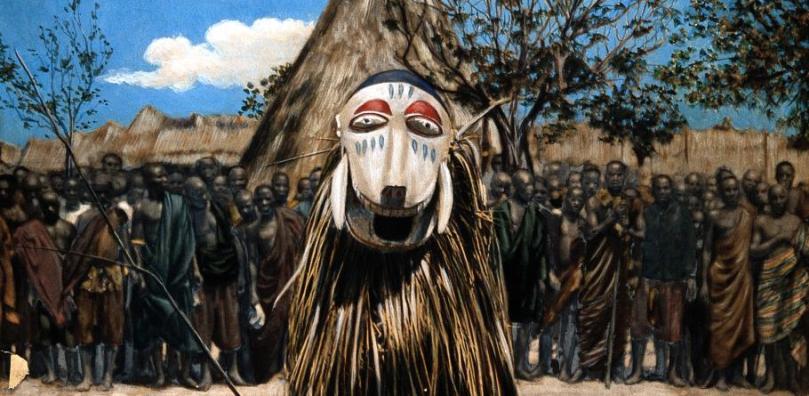
Image credit: Heywood, Paolo. (2017) 2023. “Ontological turn, the”. In The Open Encyclopedia of Anthropology, edited by Felix Stein. Facsimile of the first edition in The Cambridge Encyclopedia of Anthropology. Online: http://doi.org/10.29164/17ontology

African Time: cyclical or linear?

Mmere Dane, the Adrinkan symbol and phrase meaning “time changes.”

This is a brief synopsis of three articles discussing how societies across the African continent understand and perceive time. As usual, these answer some personal questions and open up a range of so many other questions. I hope you find them useful!

Time in traditional African thought by John Parratt

This critique of John Mbiti’s work on how African societies perceive time. Mbiti has asserted that in the African conception of time, the future is non-existent since it looks toward things and events that are yet to happen, thereby nullifying the concept of time as a linear concept composing of a past, present, and future. 

Mbiti asserts that time for the African is composed of a past and a present now being experienced, and a present which has yet to occur but the occurrence of which is certain because it is on the rhythm of nature. Mbiti’s claims are backed by the fact that certain African languages have no words to describe the concept of a future time.

Pratt argues against Mbiti’s assertions claiming that linguistics alone cannot be the basis of Mbiti’s claims about time. He cites another scholar who shows that Niangoran-Bouah in the Ivory Coast used a calendrical system to tell time, largely based on seasonal rituals. This gives rise to the claim that time in many African cultures is regulated based on certain festivals known to be held after certain intervals, for example, the New Yam Festival by the Igbos held in August.

Similarly, the Kaguru and Tiv people are observed to record time-based on events experienced by the collective groups.

This leads to the assertion of time either as oecological – relating to the cycles and rhythms of nature – or structural, relating to a person’s relationship with their society at different phases of life.

For all of his arguments against Mbiti, Parratt concludes that three overlapping circles represent time in the African perspective. He says: “Time in Africa…could perhaps be better illustrated in terms of three successive and partially intersecting circles, representing respectively the mythical past, the remembered past, and the present…a straightforward linear time scale is not involved.”

Parratt, J. (1977). Time in traditional African thought. Religion, 7(2), 117–126. https://doi.org/10.1016/0048-721x(77)90019-7

African Concept of Time, a Socio-Cultural Reality in the Process of Change 

In this paper, the authors explain that African view time as a socio-cultural phenomenon collectively experienced. Furthermore, they argue that time is a phenomenon which stretches beyond the physical realm into an ontological dimension, making it both secular and sacred. 

The authors argue that the significance of time is drawn from daily events – such as milking cattle at sunrise –  or social events – such as planting and harvest seasons.

The authors raise a point about idleness – the gap between the time for planting, harvests, and other communal events. Although, according to Europeans, Africans were often found idle and “wasting time”, the authors argue that idleness was, in fact, “preparation for time”, adding that “the economic circumstance of the day would dictate the pace of activities.”

They argue against Mbiti’s notion of no future in the African conception of time, highlighting the system of checks and balances in the old Oyo Empire, dating back to 1754. The Empire had a plan to prevent any ruling monarch from becoming either despotic or autocratic, thus making it mandatory for the Alaafin to consult the Oyomesi council of chiefs before taking decisions on the affairs of the state. According to the authors, the checks and balances in the Oyo Emirate were in place to ensure a good future and a peaceful one for the Oyo kingdom. 

According to these authors, checks and balances indicate that Africans are conscious of a distant future, contrary to what Mbiti has argued. 

Fumilola Babalola, S., & Ayodeji Alokan, O. (2013). African Concept of Time, a Socio-Cultural Reality in the Process of Change. Journal of Education and Practice, 4(7). https://www.iiste.org/Journals/index.php/JEP/article/viewFile/5290/5293

Africa’s understanding of time and history: The line over against the cycle Jan AB Jongeneel

The author argues for linear time over cyclical time while recognizing that many Africans still regard the former over the latter. According to the author, “the power of the cycle in African traditional religions and the power of the symbiosis of the cycle and the line in various circles of African Christianity, African Islam, and African secularism is much bigger than the investigated publications of Mbiti, and Bosch suggests.”

The author attests that many African societies had a cyclical approach to time, however, Judaism, and eventually, Christianity, and Islam, brought the concept of linear time to the continent. It’s worth noting here that Jongeneel asserts that the Jews were bound by “divine historical events”, which places them as forward-looking people who believe in a God that reveals his purpose for humanity over time and who will eventually bring his will to fulfilment in the “eschaton”, or at the end of time.  

This belief is in contrast with the cyclical notion of time which is referred to in the text as “reversed teleology”, where “the final purpose [of human life] is in the past rather than in the future.”

While the author references Mbiti, he introduces new scholars such as John A.A. Ayoade, who is said to have distinguished between various types of time cycles based on the traditions of Yoruba peoples in West Africa. Ayoade differentiates between the celestial/cosmic cycle, primarily concerned with the sun, moon and stars, and the terrestrial/ecological cycle, concerned with the changing seasons.

Jongeneel discusses the presence of Abrahamic religions (Judaism, Christianity, and Islam) and secularism (humanism and secularism) and how they have shaped the modern perception of time in Africa. The paper also briefly discusses the work of Asian theologians and their views of cyclical time, which is also prevalent in Hinduism, Buddhism, Taoism, and Shinto.

Jongeneel, J. A. B. (2009). Africa’s understanding of time and history: the line over against the cycle. Missionalia: The South African Missiological Society, 37(3), 37–50.

Spirit Possession: a return to wholeness?

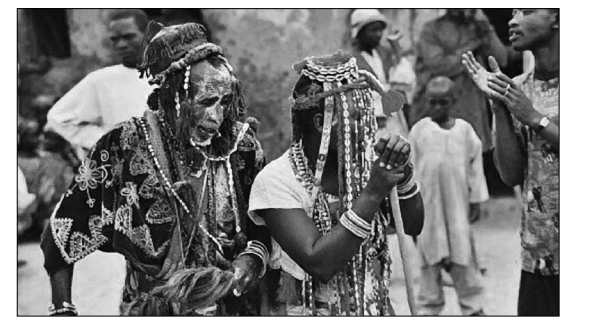
Sarkin Rafi during a Bori performance in Zaria. Source: (Okagbue, 2008)

This article continues the exploration of spirits in Hausa Animism which was shared in a previous article titled ‘Spirits (Bori/Iskoki) in Hausa Animism‘. In the previous article, we learned that the Hausas believe that spirits were at one point humans who were then condemned to live as spirits, in the unseen world, by god.

The god-made division between the spirit and human siblings had consequences, especially for the human siblings who have to spend much of their lives appeasing their spirit-siblings. The spirit-siblings, according to Sullivan (2005), have had to rely on two main mediums of expressions, “the language of malady, which expresses their displeasure at being ignored or defiled” and “the language of the adept’s body, in which [the] spirits can manifest their otherwise ethereal presence in corporeal form.” Sullivan (2005) argues that spirit possession, or Bori, is a reintegration between the long-separated siblings, which brings about a balance (wholeness) in the wellbeing of the humans who would otherwise be doomed to suffer afflictions.

This piece is an attempt to uncover if and how other belief systems across the continent are similar to Hausa Animism in the belief that humans need to foster relationships with spirits for the sake of their wellbeing and wholeness.

Ngoma: Swahili ( Tanzania)

In Tanzania, spirit possession ceremonies are called Ngoma but, beyond possession rites, they are avenues for the veneration and propitiation of spirits to obtain healing, protection and help to ward off the influence of evil spirits and witchcraft (Giles, 2018). The term Ngoma also refers to various “performance(s), drumming, dancing, celebration, and ritual therapy” (Janzen, 1992). A simple search of the term Ngoma will bring up many results, most of which fail to state that Ngoma is, in fact, first a healing/possession ceremony (Ngoma za kutibu) out of which emerged the now better known and purely entertaining form of the ceremony (Janzen, 1992).

As Janzen (1992) shows in great detail, Ngomas are often an avenue for healing. The typical scenario is this: an individual suffers an ailment of unknown causes, and after a series of consultations with traditional medicine people, it is determined that a specific spirit is responsible for the sickness. At this point, a ceremony holds to appease the spirit. In many cases, the individual becomes an initiate into the cult of the spirit responsible for their ailment.

Ngoma cults have been referred to as “cults of affliction” (Janzen, 1992), perhaps because most new adherents join after being healed from their afflictions. It is worth noting that not all members of these cults suffered ailments before they joined. Both Janzen (1992) and Giles (2018) go into detail about the differences in Ngoma cults across Tanzania. Each region has various spirits they recognize, and in many cases, these spirits are often categorized based on their location (e.g. land and water spirits), their origins (e.g. Kiarabu or spirits of Arab origins, and Kipemba spirits or native Swahili spirits), e.t.c.

So while Ngoma might, in the modern-day, be a form of entertainment, its origins emphasized the role of spirits who are responsible for afflictions from which humans sought healing.

Holle Hori: Songhay (Niger)

The belief in spirits is a central feature in the religious system of the Songhay in Niger. Similar to Swahili, they also have characterizations of spirits based on their origins and some times, race. The more contact they had with foreigners, the more their pantheon of spirits expanded. For instance, the Genji Kwari, or white spirits, were included as they interacted with the Tuareg, who at the time were Islamic dispute arbitrators. Similarly, Hausa spirits (of sickness and death), were included in the Songhay pantheon in the nineteenth century (Stoller, 2010).

The existence of these spirits necessitated a cult of worshippers and possession troupes which often included priests, mediums, singers, and instrumentalists who launched spirit possession ceremonies or Holle Hori and staged rites that allowed the interaction between spirits and humans (Stoller, 2010).

Like in Tanzania, initiates of a particular spirit cult are typically those who have suffered ailments believed to be caused and healed by the spirit a cult is dedicated to. Similarly, and in many cases, it is only after being initiated that the spirit grants reprieve from the afflictions and the new devotee can live in harmony with the spirit. New members into spirit cults are said to “devote a large part of their lives to their spirits; they wear clothes associated with them, make sacrifices to them, and attend possession ceremonies” dedicated to these spirits (Berliner, 2009).

Two Halves of a Whole

Across the spiritual traditions discussed here, we see that humans and spirits seem to have a symbiotic relationship—where the existence of one depends on the other. A thread that connects Bori, Ngoma, and Halle Hori is the belief that humans are each born with an accompanying spirit, who might inflict an affliction on individuals if and when neglected. Any form of healing or respite comes after the spirit has been sought out and appeased. In many cases, these offerings are also initiation rites for the afflicted individual who then becomes a part of the cult dedicated to the spirit that had caused their ailment.

Belief in spirits, as observed in these traditions, have broad implications including. One implication is the conviction that there are forces beyond what human senses can perceive, and that these forces have a locus of influence spanning across every aspect of existence on Earth. As expressed by the fact that most aspects of the natural world have governing spirits, from rain, ailments, trees, animals, rocks and mountains, etc.

In Bori, for instance, we see that totem animals and certain sites (rivers, mountains, hills, trees) are venerated and protected because of their spiritual significance to adherents. As a result of the value placed on these animals and sites, they are often not allowed to be hunted or killed, and the sites are protected because they are holy (Danfulani, 1999).

Another implication of the belief in spirits would be the need to preserve the natural environment while being mindful that the existence of other living things enriches human existence. As seen with Bori, certain animals were sacred because they were totemic spirits, while parts of nature were holy sites because spirits resided there (Danfulani, 1999). Likewise, in Tanzania, we see distinctions between land and water spirits (Janzen, 1992). As a result, it is safe to assume that the behaviour of any people who hold such beliefs would aim at maintaining a balanced relationship with their immediate natural environment because they believe that spirits can and often do, lash out when not propitiated.

Naturally, these implications lead to more questions like, what explanations can be we find in African belief systems for the current state of the world? How would they explain global warming, or the COVID-19 outbreak, or mental health crises, for that matter? Should we be looking to these systems for redemption?

Refrences

Dale, G. (1920). The Peoples of Zanzibar: Their Customs and Religious Beliefs. Universities’ Mission to Central Africa.

Danfulani, U. H. D. (1999). Factors Contributing to the Survival of The Bori Cult in Northern Nigeria. Numen, 46(4), 412–447. https://doi.org/10.1163/1568527991201437

Giles, L. L. (1999). Spirit Possession & the Symbolic Construction of Swahili Society. In H. Heike & U. Luig (Eds.),   Spirit Possession, Modernity, and Power in Africa  . The University of Wisconsin Press.

Giles, L. L. (2018). Translocal Interconnections within the Swahili Spirit World. In F. Declich (Ed.), Translocal Connections across the Indian Ocean Swahili Speaking Networks on the Move. Brill.

Janzen, J. M. (1992). Ngoma Discourses of Healing in Central and Southern Africa. University of California Press. https://publishing.cdlib.org/ucpressebooks/view?docId=ft3779n8vf&chunk.id=d0e440&toc.depth=100&toc.id=d0e440&brand=ucpress

Luig, U. (1999). Constructing Local Worlds: Spirit Possession in the Gwembe Valley, Zambia. In H. Behrend & U. Luig (Eds.), Spirit Possession, Modernity, and Power in Africa. The University of Wisconsin Press.

Okagbue, O. (2008). Deviants and Outcasts: Power and Politics in Hausa Bori Performances. New Theatre Quarterly, 24(3), 270–280. https://doi.org/10.1017/s0266464x08000328

Stoller, P. (2010). Fusion of the Worlds. University of Chicago Press.

Sullivan, J. (2005). Exploring Bori as a Site of Myth in Hausa Culture. Journal of African Cultural Studies, 17(2), 271–282. https://doi.org/10.1080/13696850500448378

Moon as Mother

Symbol of Nyame Amowia

Many well-known myths across the world attest that the creation of the universe was undertaken by a singular supreme being who often is male or has been largely characterized as having male attributes. In many of these creation stories, the sun is often considered the physical representation of the genitor god and creator of the universe (Diop, 2019). However, in some lesser-known origin stories, the creator of the Universe is believed to be feminine and her physical representation is in the world is the moon.

A few traditional African belief systems fall under this lesser-known group that attribute the creation of the Universe to a feminine deity. This article shares some these creation stories from West Africa where the creation of the universe is attributed to a genitrix deity.

Nyame Amowia (Akan, Ghana)

The story of Nyame Amowia was introduced in a previous article where her role as the giver of life (souls) was emphasized. However, Nyame Amowia is also the creator of the entire Universe and everything in it. This genitrix deity is also known by different names, most of which indicate some of her attributes, including Amosu, “Giver of Rain”; Amowia, “Giver of the Sun”, and Amaomee “Giver of Plenitude” (Atlanta University Center, 2020). Nyame has been referred to as “the great deity of the Akan; a self-begotten, self-produced, and self-born, [who is] at once both male and female, the Supreme Being” (Danquah, 1952).

According to Danquah (1952), Nyame Amowia separated her masculine and feminine aspects and “crystallized” her spiritual power in her soul which bears her masculine side and is represented by the sun, also known to the Akan as the deity Nyankopon. Nyame herself is personified by the moon and represented on earth by the queen-mother (Danquah, 1952). While there are accounts that stress that Nyame is in fact a male deity, it was worth noting that the belief that Nyame is female gives credence to the fact that the Akan is a matrilineal society.

Nana Bukulu (Fon, Benin)

Nana Buluku is the deity and Supreme Being of the Fon people in who from the modern-day Benin Republic. However, Nana Buluku is not directly involved with the affairs of human beings. She is believed to have created the Universe and put it under the charge of her two progenitors, Mawu and Lisa both of whom are said to have absorbed the nature of the Nana Buluku. Often referred to as “MawuLisa,” these two children of Nana Bukulu lead a pantheon of sky deities with Mawu, embodied as the moon and possessing female attributes, and Lisa, embodied as the sun with male attributes. (Ikenga-Metuh, 1982).

Mawu, the female counterpart of the sky deities, is believed to embody other attributes including fertility, motherhood, gentleness, forgiveness, rest, and joy. It is also this deity who the Fon believe was tasked with creating the world, a task Mawu seems to have carried out singlehandedly. In the narration of the creation myth as described by Ikenga-Metuh (1982), it was Mawu who formed the first human beings from clay and water, however, after creation humans were blind and helpless so Mawu sent Lisa (the sun) to give light to the earth (Ikenga-Metuh, 1982).

Across borders in Ghana, Mawu was once worshipped as the supreme deity among the Ewe people. Mawu was known by herself in this region without her accompanying sibling, Lisa, as was known to the Fon. According to Greene (2002), Mawu’s significance as the supreme being had waned significantly by the 19th century largely because the economic activity shifted from the Ewe region where Mawu reigned as supreme being to other regions of the Gold Coast (Greene, 2002).

Woyengi (Ijaw, Nigeria)

The Ijaw people of modern-day southern Nigeria believe that Woyengi – a name that translates to “great mother” – is the sole creator of the earth. While she is the only deity presented here who has not been associated with the moon,  Woyengi is believed to have descended on earth through a bolt of lightning. It is said that she stood on the edge of the universe and observed Earth filled with animals and vegetation but without humans. Using the mud from the earth, Woyengi is said to have created human dolls who were neither male nor female and afterwards, she filled their lungs with the breath of life (Asante & Mazama, 2009).

The Ijaw believe that each doll Wonyegi created was given a chance to choose their gender (male or female), the kind of blessings they wished to receive, and their occupations. Woyengi did not give a chance for the humans she created to change their minds after they chose genders, professions, and material blessings. For this reason, she came to be known as the goddess of destiny (Asante & Mazama, 2009).

Moon as a Symbol of Femininity

The analogy between women (femininity) and the moon is a feature of many cultures across the world. This connection is perhaps prevalent because of how the menstrual cycle often imitates the lunar cycle (Diop, 2019). There is another school of thought that connects the feminization of the moon to various gods of water who are often described as passive and continuous (Diop, 2019). While the latter assessment of feminine gods as passive may hold in some cultures, it is worth noting that there is nothing passive about the feminine deities whose stories have been narrated here. These deities are quite non-passive such that their adherents attribute the creation of the entire world to them.

It is also worth noting that across cultures, some feminine deities have been usurped by masculine gods. This has often led to inaccuracies in the documentation of their stories (Diop, 2019). An example is the story of Nyame Amowia, some accounts this deity (see: Edsman, 1955) ascribe masculine attributes to her, however, the fact that the Akan is a matrilineal group might be what gives credibility to the feminine attributes of this deity.

The gender attributes of deities in African Traditional Religions might seem to be trivial when taken at face value, however, gender, as many of us can attest, often determines status in society, among other profound effects. Now, imagine what assigning gender, or even misattributing it, can do for a god its believers.

Sources:

  • Asante, M. K., & Mazama, A. (Eds.). (2009). Encyclopedia of African religion. Thousand Oaks, Calif: SAGE.
  • Atlanta University Center. (2020, July 16). Traditional African Religions: Akan. Atlanta University. Retrieved May 29, 2021, from https://research.auctr.edu/c.php?g=404402&p=2752856
  • Danquah, J. B. (1952). The Culture of Akan. Africa: Journal of the International African Institute, 22(4), 360–366. Retrieved May 29, 2021, from http://www.jstor.org/stable/1156919
  • Diop, I. S. (2019). African Mythology, Femininity, and Maternity. Springer Nature.
  • Edsman, C.-M. (1955). The Sacral Kingship / La Regalità Sacra. Rome, Italy: BRILL.
  • Greene, S. E. (2002). Sacred Sites and the Colonial Encounter. Indiana University Press.
  • Ikenga-Metuh, E. (1982). Religious Concepts in West African Cosmogonies: A Problem of Interpretation. Journal of Religion in Africa, Vol. 13 (1982)(1), 11–24. Retrieved May 29, 2021, from http://www.jstor.org/stable/1581115

Of Cycles, and What Happens When We Die

Owuo Atwedee, the Adrinka symbol known as “ladder of death”, representing man’s mortality

Those of us in the Northern Hemisphere just marked the Vernal Equinox. This is the day the Sun crosses the equator and begins traveling towards the Southern part of the globe. Having spent the last six months in darkness (think shorter days, winter), the Vernal Equinox marks the beginning of Spring in the Northern Hemisphere. The keenly observant will notice more hours of sunlight, aka, longer days. 

As one part of the world embraced more light, another part begins to experience its absence. The Southern Hemisphere also just marked the beginning of Autumn, a period which is largely characterized by long nights and shorter days. 

In African traditional thought, it is believed that our lives, and indeed death, are continuous events not unlike the cycles we observe in nature such as the beginning of Spring and Autumn which both occur at the same time but mean and look different depending on which side of the equator one finds themselves. 

Death is perceived not as an ending, rather, as a continuation of a cycle that began before we materialized in this realm and will continue long after our souls have taken flight from it. The beliefs of the Akan, a group now predominantly in modern-day Ghana, put this in perspective. 

From Nyame We Came… 

According to the Akan, our lifeforce (soul) comes from the genitrix deity and creator of the universe, Nyame Amowia, whose physical manifestation is the moon. It is believed that a child is born after it receives the life force, known as Kra, given by the Sun deity, Nyankopon, who acts on behalf of Nyame Amowia. Sometimes a child might receive the Kra of an ancestor who failed in a previous life to be a good human. Nyankopon condemns such a person’s soul to perpetual reincarnation until a descendant reincarnated on earth attains good spiritual standing. It is only then that the soul can once again become one with Nyame’s eternal Kra (Meyerowitz, 1951).

The Kra is often mistaken with a closely related concept known as the Honhom which translates to “breath.” The Akan are known to say “ne honhom ko,” when a person passes away. This translates to, “his breath is gone.” Alternatively, they say “nekra afi ne ho,” translating to “his soul has withdrawn from his body” (Frimpong, 2011). 

…To Nyame We Shall Return

While the statements above are similar, Kra and Honhom are two distinguishable concepts. Honhom, breath, inadvertently symbolizes the presence of Kra in any living human being. Consequently, when a person dies (stops breathing), it is said that the Honhom leaves, and, logically, the Kra is also believed to have departed from the body (Danquah, 1952).

After death, it is said that the Honhom flies back, in the shape of a bird, to the mother and creator of the universe, Nyame. The soul, however, is left to labor up a steep hill until it reaches Nyankopon who will then judge and determine if the soul has to return (reincarnate) to earth, or if it can proceed to become one with the Nyame. 

The Dead are Never Dead

According to Okwu (1979), in African traditional thought, the physical plane of existence where humans inhabit and the spiritual plane are essentially two sides of the same coin. As such, life on earth can be explained as the side of the coin where the soul, “the seed of the creator” is seen to exist in a conscious, physical, and integrated union with the material body. Consequently, across various African belief systems, death is not regarded as the end of existence, rather as the ultimate rite of passage each human being has to go through (Okwu, 1979).

The belief in a spiritual plane of existence – unseen, untouched, and inaccessible to us humans – fuels ancestral veneration, or what many Western scholars have inaccurately referred to as “ancestral worship.” Okwu (1979) states: “the members of the supernatural world are regarded as an integral part of the material world. This implies that in important human social functions, such as marriages, birth and naming ceremonies, initiation, and healing, the opinions and/or approval of the members of the spirit plane are not merely invoked and observed; their participation and benediction are also requested.” (Okwu, 1979). 

John Mbiti, a foremost scholar of African religions, asserts that even the language used when talking about death and dying across various parts of the Continent often implies a sort of home-going for the departed. This is also indicated by various customs and rituals which can be observed during funerals. For example, various groups across the Continent are known for burying their dead with various paraphernalia and household items such as food, stools, tobacco, clothing, etc. These items are believed to be needed on the journey to the next world (Mbiti, 1970).

So What?

Across the Continent, many beliefs are cyclical rather than linear in nature. This means that many cultures hold the belief that life has no end; like the sun, our souls continue to move in a cyclical motion. We are a part of the divine before we are born and when our breath and soul leave our physical bodies, they continue to journey on a path that ultimately leads back to the creator. As Mbiti (1970) says: “death is death and the beginning of a permanent ontological departure of the individual from mankind to spirithood.”

Sources

Danquah, J. B. (1952). The Culture of Akan. Africa22(4), 360–366. 10.2307/1156919

Frimpong, A. D. (2011, December 1). Purity And Impurity: Menstruation And Its Impact On The Role Of Akan Women In The Church. Vrije Universiteit Amsterdam. https://research.vu.nl/en/publications/purity-and-impurity-menstruation-and-its-impact-on-the-role-of-ak

Mbiti, John. S. (1970). African religions & philosophy. Heinemann.

Meyerowitz, E. L. R. (1951). Concepts of the Soul among the Akan of the Gold Coast. Africa21(1), 24–31. 10.2307/1156155

Okwu, A. S. O. (1979). Life, Death, Reincarnation, and Traditional Healing in Africa. Issue: A Journal of Opinion9(3), 19. 10.2307/1166258

Traditional African Religion and Social Resistance Movements

October 2020 will be remembered for a long time as a pivotal moment of change in the history of Nigeria. The fact that the country marked the 60th anniversary of its independence in the same month is perhaps a mere coincidence with the uprising that occurred days later. Though an intimation with the nature of colonial trauma, the inherited vestiges of disdain and disregard for African lives that police brutality and other malaise signify, instruct us that perhaps the 60th independence of Nigeria was in fact a catalyst for the uprising.

Whichever way you look at it though, no one could have anticipated that it was at this important point in the history of Nigeria that Nigerian youths would rise in unprecedented numbers to demand an end to years of police brutality, as well as accountability from leaders, and a truer and more creatively imagined independence from a colonial hierarchy of being.

The resistance in Nigeria is one of many that have occurred across the continent in the year 2020, even though the world had been brought to its knees by a pandemic. In South Africa alone, a total of 511 protests were recorded from 27 March to 31 July 2020. Namibians, particularly women, were also out on the streets in the same period as the Nigerian protests demanding an end to widespread gender-based violence. Meanwhile, in Mali, we saw thousands march in the street to demand an end to poor leadership.

The year 1960 is referred to as The Year of Africa because, in that year, at least 17 African nations became independent from their colonial rulers. These countries all have interesting stories about the movements, and in many cases, the resistances, that led to their independence and the fact that a wave of movements and resistances are being witnessed exactly 60 years later can seem to be more than a coincidence.  Social resistance is nothing new in Africa, however, the fact that we have better tools to organize, report, fundraise and support each other across borders and physical barriers, is perhaps what has made some of these movements as monumental as they have ever been.

In keeping with the theme of resistance, this piece takes a look at how elements of two African belief systems influenced two major social resistance movements in colonial Africa.

The Chimurenga Resistance (Zimbabwe, 1896-1897)

In any social movement, religion can either be a catalyst or an inhibitor. These roles are represented by Max Weber’s notion of a “proactive religion” which can lead to socio-economic transformation; and Karl Marx’s notion of a passive religion, where he famously describes it as the “opium of the people” and consequently incapable of bringing about any kind of social change within oppressive systems.

The story of the Chimurenga Resistance exemplifies how religion and religious elements can serve as catalysts for social change. Chimurenga is attributed to the Shona people and can be translated as “revolutionary struggle” or “uprising”.

Like many colonized countries on the continent, the colonization of Zimbabwe happened through a web of deceit and violence perpetrated by the British South African Company in the early 1890s. The British South African Company employed a specific method of divide and conquer, or indirect rule,  which has been attributed to Fredrick Lugard.

The indirect rule sought to outlaw spirit mediums and rely solely on traditional rulers to help establish colonial authority within colonies. The system employed local chiefs to serve as ‘mouthpieces’ and ‘right hands’ (Fields, 1985), on behalf of colonizers who sought to control the chiefs for the ultimate aim of controlling the people. However, the colonizers failed to consider the fact that across many African societies, there isn’t typically a separation between the political, social and religious aspects of life and this meant that spirit mediums, known as n’angas, were just as powerful and influential as traditional chiefs (Kaoma, 2016).

To establish the dominion of chiefs over their localities, the colonizers outlawed n’angas and this set the stage for the influential roles spirit mediums played during what is now known as the First Chimurenga. According to Kaoma (2016), the attempt to outlaw spirit mediums and to denounce witchcraft and superstitions also created a social crisis which resulted in an undermining of the authority of chiefs whom themselves depended on spirit mediums for their authority.

Expulsion from their ancestral lands and imposed taxes further compounded the grievances that the Shona and Ndebele had against their colonizers. So, between 1896 and 1897, the Shona and the Ndebele communities, through the help of n’angas, violently rebelled against the British South African Company.

The rebellion was led by spirit mediums who were adherents of the Mwari Deity or ancestral cult. The mediums who communicated with Mawri and channelled the deity’s messages to the community were mainly women and Kaoma (2016) emphasized the fact that Mwari’s voice was a woman to highlight the important role women played within the belief system as well as the resistance movement.

The deity Mawri is quoted as attributing various misfortunes including severe drought, a locust invasion, disease in cattle and violent deaths to the arrival of colonizers. The deity thus called for the Shona and Ndebele people to “go and kill these white people and drive them out of our father’s land and I Mwari will take away the cattle disease and the locusts and send you rain.” (Daneel 1970, as cited in Kaoma, 2016).

With that, the spiritual leader, known as Mlimo, led nearly 2,000 warriors to fight against the British. It is said that the power of the Ndebele warriors peaked during the full moon and with that knowledge, their first attack was carried out on the night of March 29, 1896, beneath a full moon.

Eventually, the leaders of the rebellion were conquered and sentenced to death by the British, however, they were evoked by nationalist leaders and adherents of the Mawri deity to mobilize support for the Second Chimurenga which eventually led to the independence of Zimbabwe in 1980 (Kamao, 2016).

The Majimaji War (Tanzania, 1904-1908)

The Majimaji War saw Tanzanians rise in resistance against colonization by Germany. Leaving an estimated 100 to 300,000 southern Tanzanians dead, it has been described as one of the most catastrophic wars of colonial Africa (Rushohora, 2019). Like in Zimbabwe a decade earlier, the Majimaji resistance was initiated by a spirit medium named Kinjekitile Ngwale. The resistance was a result of frustration with years of German colonization which featured forced labor, torture, and unfair tax systems. 

Ngwale, described as being possessed by a snake spirit called Hongo, was able to mobilize various groups to take part in the uprising. He was a powerful medicine man who gained popularity in the years leading up to the war. As word spread about him, people began traveling to see him as it was widely believed that his medicine provided several benefits including good health and harvest. However, most notably, Nwgale was popular for claiming to have found a way to repel German bullets. His secret was healing water which he referred to as Majimaji, and could “give invulnerability, acting in such a way that enemy bullets would fall from their targets like raindrops from a greased body.”

A study analyzing the coordination of the Majimaji resistance emphasizes the role of “witchcraft” in coalescing various groups of people to struggle against a common enemy (Iliffe, 1967). According to John Iliffe (1967), the group of mediums led by Ngwale were most likely the religious counterparts of the mediums responsible for the Chimerunga Resistance years earlier. However, the mediums in Tanzania were adherents of a serpent deity and were referred to as the Kolelo cult and believed to have possessed supernatural elements including mediumship, possession, and command over death  (Iliffe, 1967).

Tanzanian warriors, armed only with arrows, spears, and Majimaji water, thus launched an offensive against the Germans, first attacking small outposts, before spreading throughout the colony. Eventually, the Majimaji War involved 20 different ethnic groups all fighting towards dispelling German colonizers.

The Role of Religion in Modern Resistance Movements

In a modern, increasingly globalized and multicultural world, what role can religion play in resistance movements such as the #EndSARS or #BlackLivesMatter movements?

Nepstad & Williams (2007) argue that religion provides important organizational resources including networks of members, meeting spaces, fund-raising capacities, leadership, and free spaces to promote the development of organizing skills, etc. However, beyond these, religious institutions can also offer theological and ideological critiques of existing social issues such as the wanton killings and brutalization of people by agents of the state. Even within multicultural societies where there might be an absence of a unifying ‘Cultural Religion’ (the overlap between cultural and religious elements (Nepstad & Williams, 2007), extant religious institutions can still render themselves useful to modern resistance movements.

However, whether or not existing religious institutions are willing to lend their voices to resistance movements is another area of inquiry entirely. If the response of religious institutions in Nigeria to the  #EndSARS movement is any indication, then it can safely be concluded that religious institutions, or at least those in Nigeria, cannot be expected to fully and outrightly support resistance movements. This conclusion is largely drawn from the loud silence that has emanated out of the pulpits of some of the world’s largest megachurches based in Nigeria.

Asides from mega-pastors and churches, other religious entities have also been largely mute during the #EndSARS movement. The Association of Nigerian Witches and Wizards, known to have declared its support in 2014 during the fight against Boko Haram, has largely been quiet. So has the Muslim religious body in Nigeria.

So What?

As seen with the Chimurenga and Majimaji movements, a shared cultural religion was pivotal in bringing together different groups which collectively participated in both movements. However, and perhaps, largely due to the suppression of African religions, we are likely never to see a similar uprising as either the Chimurenga or the Majimaji which were both entirely inspired and dependent on various aspects of the prevailing African belief systems.

Still, there are various concepts from African religions that can inspire modern resistance movements, after all, as John Mbiti has asserted, Africans’ belief in God has always engendered a moral response which has directed moral life and interaction long before the first European settlers came with their religions and philosophies.

Sources

  1. Beverton, A. (2009, June 21). Maji Maji Uprising (1905-1907). https://www.blackpast.org/global-african-history/maji-maji-uprising-1905-1907/#:~:text=A%20prophet%E2%80%94Kinjikitile%20Ngwale%E2%80%94emerged,against%20the%20Germans%2C%20attacking%20atBritish
  2. Broadcasting Corporation. (n.d.). The Story Of Africa| BBC World Service. Retrieved October 28, 2020, from  http://www.bbc.co.uk/worldservice/africa/features/storyofafrica/11chapter7.shtml
  3. Emory University. (2016). The Maji Maji Rebellion | Violence In Twentieth Century Africahttps://scholarblogs.emory.edu/violenceinafrica/sample-page/the-maji-maji-rebellion-2/
  4. Hay, M. (2014, October 28). The Association Of Nigerian Witches And Wizards Is Helping To Fight Boko Haram. VICE. https://www.vice.com/en/article/5gkqnn/the-association-of-nigerian-witches-and-wizards-is-a-thing-and-they-are-helping-fight-boko-haram
  5. Ikechukwu, P. (2019, February 21). The Essence Of African Traditional Religion. Church Life Journal. https://churchlifejournal.nd.edu/articles/the-essence-of-african-traditional-religion/
  6. Iliffe, J. (1967). The Organization of the Maji Maji Rebellion. J. Afr. Hist.8(3), 495–512. https://doi.org/10.1017/s0021853700007982
  7. Nepstad, S. E., & Williams, R. H. (2007). Religion in Rebellion, Resistance, and Social Movements. In J. A. Beckford & N. J. Demerath III (Eds.), The SAGE Handbook of the Sociology of Religion. SAGE. https://sk.sagepub.com/reference/hdbk_socreligion
  8. Rushohora, N. A. (2019). Facts and Fictions of the Majimaji War Graves in Southern Tanzania. Afr Archaeol Rev36(1), 145–159. https://doi.org/10.1007/s10437-019-09324-2

About African Religions

Our ancestors prayed, believed, worshipped, and called on God in various ways before the first mosques and churches were ever established on the continent. Just as there are currently diverse people and cultures on the continent, with over 3000 ethnic groups, so were the beliefs and spiritual practices of pre-colonial Africans diverse, such that we could spend lifetimes studying them and we would never exhaust them all. 

Because of the diversity of religious and spiritual beliefs on the Continent, many researchers who have previously studied them have done so by observing a few, making comparisons between them, and then making broad conclusions and generalizations about the basic tenets and characteristics of what they collectively refer to as “Traditional African Religions”. 

While the generalizations perhaps allowed for easier access to and analysis of  African religions, they have also inadvertently allowed for the reduction of African religions to a monolithic set of beliefs and practices. This reductionism is exemplified in the attempt to use the name “traditional African religion” to imply a single religion, much like Christianity and Islam, which is expected to encompass all the beliefs and practices of non-Christian and non-Muslim religions on the continent1. This reductionism is problematic because — perhaps without intending to — it erases certain unique aspects of African religions on the continent by focusing simply on the similarities between them.

Jacob Olupona, a leading scholar of African religions, asserted that a truly indigenous understanding of African religions has to begin with understanding the history of Africa before colonization because our current knowledge of African religions and their accompanying practices are deeply rooted in non-African paradigms and Eurocentric ideas2

So then, the question becomes, how do we begin to seek this understanding of pre-colonial Africa which is not rooted in Eurocentric views? And how do we dislodge African religions from the Eurocentric point of view which has so far demonized, reduced and attempted to erase them? 

These are some of the foundational questions that have led to the creation of this platform. This site is intended in to be a space that fosters an understanding of African Religions which, as much as possible, is not centred in Eurocentric views. This attempt to dislodge African beliefs from the Eurocentric view is depicted in the chosen name for the site; African Religions, rather than ‘African Traditional Religions,’ because when we talk about Christianity or Islam, for instance, we do not refer to them as Hebrew or Arabic  Traditional Religions, or perhaps even collectively as Middle Eastern Religions. If we are specific when we talk about those religions, we ought to begin to adopt a similar approach when we speak about and study African religions. And although the term ‘African Religions’ still refers to the diverse spiritual beliefs and customs as a collective, it is not done in an attempt to categorize them all as a single religious entity. Additionally, erasing the word ‘traditional’ is an attempt to centre these beliefs and make them less of an ‘other’ in our discourse. 

As scholars continue to emphasize globalization and the emergence of “new African religions” — which include African beliefs syncretized with either Islam or Christianity and those that made it to the Americas as a result of the trans-Atlantic slave trade — it is imperative to understand how these ‘older’ beliefs have influenced the so-called new religions.  An ancient principle which this work is based on is Sankofa, from the Akan people of Ghana. The concept reminds us that “it is not taboo to fetch what is at risk of being left behind.” 

One might wonder why it is necessary to preserve these spiritual beliefs, or at least what is left of them, and a response to that is culled from the work of Kofi Asare Opoku (2006) who has asserted that African religion is inextricably linked to all aspects of African life3. Opoku highlights that the word ‘religion’ is missing from many African languages because these African cultures do not make a distinction between their spiritual beliefs and other key aspects of life including ways of organizing society, governance, etiquettes and customs, etc. And so, by abandoning these spiritual beliefs, many African societies are at risk of losing their identities; the very principles and tenets which give meaning to their existence. 

The goal, therefore, is to help those already on the path to remembering by providing various resources about the different beliefs and practices that existed, and still do, across the Continent. The information available here is also aimed at people who are not yet on the path to remembering but wish to be. It is hoped that the resources here will fuel your curiosity about your Ancestors and spark within you a desire to know more about how they lived and what they believed for the ultimate purpose of enriching your life and freeing your mind. The overarching goal is for the site to be a digital catalogue of resources and information for scholars and researchers whose works are centred on African religions. 

The site will be updated monthly with new resources and articles and I invite you to subscribe to receive them directly in your inbox. Also, send me questions about the ideas, concepts, myths and misconceptions you are curious about. I am making it my mission to dig deep into as many topics on African Religions as possible.

Sources

1. MacGaffey, W. (2012, October 25). African Traditional Religion. Retrieved July 18, 2020, from https://www.oxfordbibliographies.com/view/document/obo-9780199846733/obo-9780199846733-0064.xml

2. Olupona, J. (2006). Thinking Globally about African Religion. In M. Juergensmeyer (Ed.), . Oxford University Press. Retrieved July 18, 2020, from https://www.oxfordhandbooks.com/view/10.1093/oxfordhb/9780195137989.001.0001/oxfordhb-9780195137989

3. Opoku, K. A. (2006). Traditional African Religious Society. In M. Juergensmeyer (Ed.), . Oxford University Press. Retrieved July 23, 2020, from https://www.oxfordhandbooks.com/view/10.1093/oxfordhb/9780195137989.001.0001/oxfordhb-9780195137989