If you have ever scrolled through social media during, as most of us are now incessantly fond of doing, you will notice that astrology is everywhere. From the infamous Mercury retrograde posts, to new and full moon celebrations, and the often-feared and misunderstood phenomenon of eclipses. Astrology is everywhere and has since become a global, multibillion-dollar industry centered on the relationship between human beings and the celestial bodies above us.
Yet, when you think of astrology, rarely do you hear any mention of Africa. For the OG astro-heads, you might have learned about the differences between Tropical and Sidereal Astrology; one is largely Western-centric, and the latter, emerging from Eastern cultures, specifically Babylonia. In the mainstream conversations about astrology, the influence of Africa is largely absent, and it is certainly not because Africans did not look up to the stars.
Quite the opposite. If you consider that Africa is the birthplace of humanity, then it naturally follows that Africa is where humanity’s relationship with the cosmos began. Long before the ancient Greeks and Babylonians, and long before the zodiac as the West now knows it was drawn up and exported around the world, the various peoples of Africa maintained an intricate knowledge of the stars upon which they ordered their lives and societies. The use of astrology by Africans influenced farming and harvest seasons, many rituals, and ultimately, the understanding of what it means to be human in a vast and living universe.
This post is an attempt to bring some of that knowledge back into the light.
A quick note before we dive in: the separation of astronomy — considered a legitimate science — from astrology — dismissed as superstition — is not a universal truth. It is a Western invention, a product of the post-Enlightenment Scientific Revolution. Ancient Africans practiced both as one unified knowledge system, and that wholeness is precisely why their cosmology was complete.
The First Astronomers: Nabta Playa
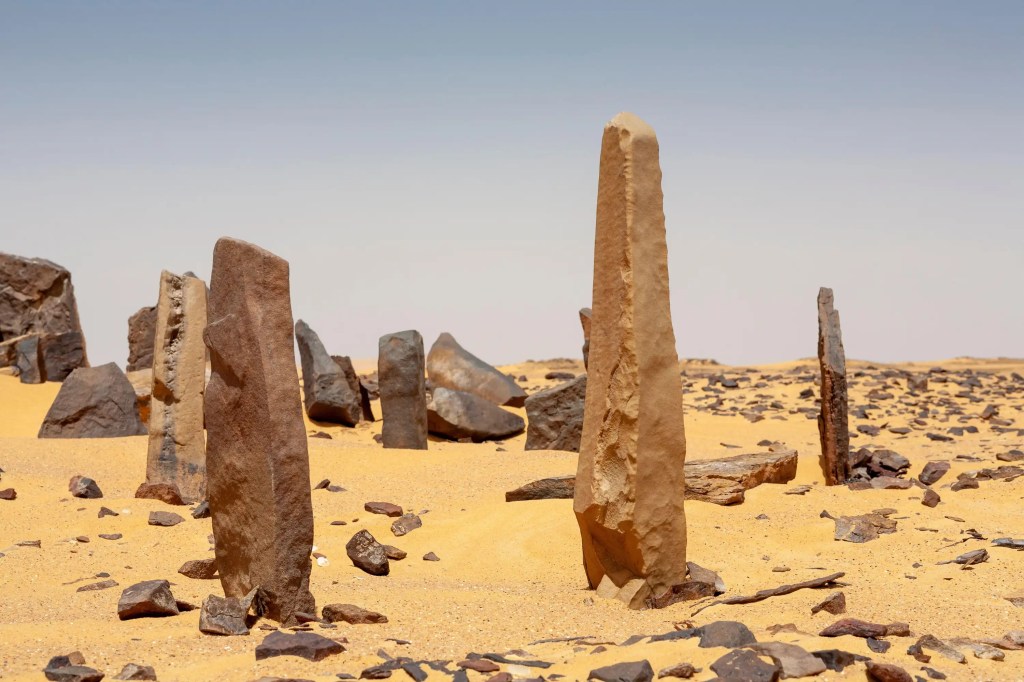
Nabta Playa is the oldest known astronomical site on Earth — predating Stonehenge by several millennia, with a calendar circle constructed as far back as 7,000 years ago. The stone circle at Nabta Playa is located approximately 800 kilometres south of modern Cairo, in a stretch of the Nubian Desert near the Egyptian-Sudanese border. The stone circle was a prehistoric calendar that helped mark two significant celestial phenomena — the summer solstice, which signalled the onset of summer rains and the flooding of the Nile, and as a sky map which helped the builders understand the arrangement of stars in the night sky and relied on it as a guide through the desert.
Since its discovery, satellite surveys have confirmed what was theorized about this stone circle: its alignments were used to track the rising of Arcturus, Sirius, and Alpha Centauri. The repetitive orientation of large stone monuments, human burials, and cattle burials all facing the northern regions of the sky reveals an early symbolic connection between the earliest humans and the heavens. This connection, transcending science, shows a profound spirituality in which life, death, water, cattle, Sun, and stars were not separate domains of existence but rather a unified living system.
The people of Nabta Playa were sub-Saharan African pastoralists, nomadic herders who moved with the seasons and, in so doing, learned to read the sky, relying on it as a guide. It has been posited that, when the Sahara began to dry around 5,000 BC, these communities migrated northeast toward the Nile, carrying their cosmological knowledge with them. If this turn of events is indeed true, then the astronomical sophistication associated with ancient Egypt, the alignment of temples with the solstices, and the mythologies woven around Sirius and Orion may have roots even older than Egypt itself.
Namoratunga: East Africa’s Stellar Calendar
Just under 2,000 kilometres south of Nabta Playa, near Lake Turkana in modern-day Kenya, stand the Namoratunga stones. The site features an alignment of 19 basalt pillars oriented toward specific stars and constellations, which modern eastern Cushitic peoples still use to calculate an accurate calendar. The pillars date back to about 300 B.C., over 2000 years ago, and confirm that a prehistoric calendar based on detailed astronomical knowledge was in use in Eastern Africa.
Here again, we find evidence of indigenous African astronomical precision: a calendar system not imposed by external forces, one developed by the people who needed and used it. The Cushitic communities of East Africa used the stars to time their agricultural cycles, their ritual calendars, and their social gatherings.
While Nabta Playa is the oldest known astronomical site on Earth, Namoratunga is the first archeoastronomical evidence located in Sub-Saharan Africa. It provides evidence that rather than spectators of a cosmic unfolding, ancient Africans were intimately involved with the stars. The stars the Ancient Turkana people observed include Triangulum, Pleiades, Bellatrix, Aldebaran, Central Orion, Saiph, and Sirius, collectively known as the Borana Stars, which formed the basis of a 12-month calendar, also known as the Borana Calendar, consisting of 354 days.
The Dogon of Mali: When Africa Knew Too Much
Perhaps no example of African astronomical knowledge has generated as much controversy within the scientific community as that of the Dogon people of Mali. The Dogon people of Mali possess, perhaps, the most extensive knowledge of astronomy of any known peoples in Sub-Saharan Africa. Their extensive knowledge of the Sirius star system, particularly Sirius B, a smaller, white star invisible to the naked eye, has set the Dogon far ahead of modern science. Similarly, the oral traditions of the Dogon also described the moons of Jupiter and Saturn, long before Western astronomers documented them. Their knowledge of Sirius B included details about its orbital period and its extraordinary density, information that modern science only confirmed in the twentieth century.
The response from Western academia to the Dogon’s extensive knowledge of the stars has been illuminating in the worst possible way. Scholars, including PBS astronomer Carl Sagan, speculated that the Dogons’ knowledge of celestial bodies must have come from European or extraterrestrial influence rather than from independent intellectual observations. For some scholars, the choice was between aliens and Europeans as the source of Dogon astronomical knowledge. The idea that the Dogon might simply have known, through centuries of careful, sophisticated inquiry, was apparently too difficult to accommodate.
Admittedly, the Dogon also claim that encounters with extraterrestrial entities informed their extensive knowledge of the stars. Dogon folklore maintains that knowledge of Sirius was handed down to them by amphibious beings, Nommo (which means “to drink”), whom they encountered as they migrated from their ancestral homelands. According to the Dogon, the aliens came from the Sirius star system and appeared to have human torsos and snake-like lower bodies.
Whether or not their extensive knowledge of the star system was self-engineered or handed down by human aliens or extraterrestrials, the same epistemic violence that dismissed animism as superstition, that reframed African governance systems as primitive, that renamed the gods of our ancestors as demons, this same violence has been applied to African science, and specifically African knowledge of the stars. Thus, the Dogon’s knowledge was either appropriated or delegitimised, rather than simply respected for its uncanny accuracy even without the use of modern technology.
Notwithstanding, the Sirius star system is cosmologically central for the Dogon, and the Nommo, the spiritual beings associated with water and creation, were said to have descended from the Sirius system, bringing with them the knowledge that seeded Dogon civilization. The Dogon had their own systems of astronomy and calendrical measurements, methods of calculation, extensive anatomical and physiological knowledge, and a systematic pharmacopoeia. The cosmos, for the Dogon, was not separate from medicine, governance, or spirituality. It was the same conversation.
The Orisha as Cosmic Forces
In the Yoruba spiritual tradition — which has been explored extensively in relation to Yemoja, Oshun, and the divine feminine — the relationship between the heavens and human life is woven into every dimension of practice.
The Yoruba believe that there are 400 Orisha, each a different aspect of nature serving as earthly representations of the cosmos and heavenly energies. Nothing exists or happens in the sky that does not have its influence or vibration on Earth within nature’s elements, and also in human behavior. Using this framework, we see that what Western astrology calls “planetary influences” are, in Yoruba belief, the personalities and domains of specific Orisha: Shango, for instance, is the force of thunder, Ogun, the energy of iron and action, and Oshun as the pull of Venus toward love, creativity, and flow.
Between 10,000 and 6,000 BC, the Africans of the Nile valley and the great lakes region devised the stellar calendar. In 4,000 BC, the solar calendar marked the era of a new age. The Ifá divination system — one of humanity’s oldest and most sophisticated oracular traditions, now protected by UNESCO as Intangible Cultural Heritage — uses the Opon Ifá, a divining board that is similar to the astrological birth or natal chart, divided into twelve houses equalling thirty degrees, the distance it takes the Sun to travel in a day. This is astrology. It is simply astrology that has not been called that, perhaps because naming it would require acknowledging that Africa gave this knowledge to the world, not the other way around.
Women and the Sky
Any celebration of African astrology must pause on the particular intimacy between women and the heavens, an intimacy that runs through so many of the Continent’s traditions.
In Ancient Egypt, the sky goddess Nut is said to swallow the Sun every night, giving birth to it again in the East every morning. Her daughter Isis — associated with the star Sirius — follows her husband Osiris (the constellation Orion) across the sky. Isis and Hathor were both connected to Sirius, the brightest star in the night sky, and it was the heliacal rising of Sirius — its first appearance on the horizon before sunrise after a period of invisibility — that marked the beginning of the Egyptian new year and the flooding of the Nile.
Goddess as calendar. Goddess as an agriculture, and Goddess as a star.
Similarly, the |Xam people of South Africa, a girl creates the Milky Way by throwing ashes and roots into the sky. The Arimi of Tanzania named the Pleiades “Kiimia”, also known as the supreme wife and mother, whose return in September marked the end of the dry season and whose very being represented cherished ideals for women. The Tuareg of the Sahara called the individual stars of the Pleiades each by a name, and collectively referred to them as “girls of the night.”
In other cultures on the Continent, the moon is ascribed feminine attributes and thus revered for its power to regulate menstrual cycles and initiate women into womanhood. For example, the Luba of the Democratic Republic of Congo, the white light of the moon was associated with insight gained during spirit possession ceremonies, and among the Nga of Nigeria, ritual and domestic space is organised according to moon phases.
Why This Matters Now
It would be easy to frame this as a history lesson. But I do not think it is only that.
We live in a moment when many people — particularly those of African descent, and those who have grown up at the intersection of modernity and ancestral erasure — are searching for something. We scroll through astrology content, looking for a language that helps us make sense of our lives, buying birth chart readings from apps that reflect Greek planetary mythology and Hellenistic house systems, both of which stem from traditions that themselves drew heavily on Babylonian and Egyptian sources. Without knowing it, we consume diluted derivatives of knowledge that once belonged to our ancestors in a far more whole and living form.
In contemporary African societies, there is still a lingering disdain for traditional ancestral systems that guided our ancestors’ lives. While in diasporic African communities, the movement to reconnect with traditional beliefs appears to be gaining momentum, this revival is driven by a desire to reclaim ancestral knowledge that was once forcibly taken away and repressed to separate enslaved Africans and their descendants from their cultural identity.
African astrology, in its various forms, was never primarily about self-knowledge in the individualistic Western sense. It centered on relational knowledge, understanding one’s place in the web of seasons, spirits, community, and cosmos. It was about knowing when to plant, when to grieve, when to celebrate, and when to call upon the Ancestors. It was a practice of listening to the sky, to the land, and to the invisible presence that moves through both.
It is this vital connection to all life around us that was lost once separated from our cultural knowledge and identities. As such, reclaiming these lost aspects, and specifically centering African astrological knowledge and practices, is not simply nostalgia. It is, as I have argued before in this space, the work of re-indigenisation. It is the work of remembering that we were a complete people before any of what we now call “history” attempted to make us forget.
The stars have always guided and reflected us to ourselves, and after centuries of separation, it is time we remembered and honored our connection to them.
Further Reading & Sources
- Holbrook, J., Medupe, R. T., & Urama, J. O. (Eds.). (2008). African Cultural Astronomy: Current Archaeoastronomy and Ethnoastronomy Research in Africa. Springer.
- Malville, J. M., Schild, R., Wendorf, F., & Brenmer, R. (2008). “Astronomy of Nabta Playa.” In African Cultural Astronomy, pp. 131–143.
- Griaule, M., & Dieterlen, G. (1965). Le Renard Pâle. Institut d’Ethnologie, Paris.
- Holbrook, J. (2020). “A Glimpse into African Cultural Astronomy.” Astrobites. https://astrobites.org/2020/08/28/african-cultural-astronomy/
- Warner, B. (1996). Traditional Astronomical Knowledge in Africa. South African Astronomical Observatory.
- Ogunbusola, S. I. (n.d.). “West Africa’s Orisha and Orisa Astrology.” Ileifa. https://ileifa.org/orisha-astrology/
- African-Volunteer.net. “Traditional African Astrology.” https://african-volunteer.net/african_astrology.html
- Vannier, Christian. (2019, July 12). “African Cultural Astronomy.” Anthropology News. DOI: 10.1111/AN.1221. https://www.anthropology-news.org/articles/african-cultural-astronomy/
- Smithsonian National Museum of African Art. (2012). African Cosmos: Stellar Arts [Exhibition]. National Museum of African Art, Washington, D.C. https://africa.si.edu/exhibitions/african-cosmos-stellar-arts
- Holbrook, Jarita C. (2007). “African Cultural Astronomy.” African Skies, 11. https://adsabs.harvard.edu/full/2007AfrSk..11….8H
- Astronomical Society of Southern Africa. (n.d.). “Ethnoastronomy.” Astronomy in South Africa. https://assa.saao.ac.za/astronomy-in-south-africa/ethnoastronomy/
- Effiong, Philip U. (2013). “The Dogon and the Sirius Star: Fact or Coincidence?” Michigan State University. https://effiongp.msu.domains/wp-content/uploads/2018/08/Dogon-Star.pdf
- Sheposh, Richard. (2023). “Nommo (Ancestral Spirits).” EBSCO Research Starters: Religion and Philosophy. https://www.ebsco.com/research-starters/religion-and-philosophy/nommo-ancestral-spirits
- Pahima, Freddy. (2025, January 4). “Social Perception of Eclipses Among the Mossi and Yaana of Burkina Faso.” Right for Education. https://rightforeducation.org/2025/01/04/eclipses-among-the-mossi-and-yaana-of-burkina-faso/
- Snedegar, K. (2000). “Astronomical Practices in Africa South of the Sahara.” In Selin, H., & Xiaochun, S. (Eds.), Astronomy Across Cultures: The History of Non-Western Astronomy. Science Across Cultures: The History of Non-Western Science, vol. 1. Springer, Dordrecht. https://doi.org/10.1007/978-94-011-4179-6_16
- Chami, Felix A. (2008). “Evidence of Ancient African Beliefs in Celestial Bodies.” In Holbrook, J., Medupe, R. T., & Urama, J. O. (Eds.), African Cultural Astronomy. Springer. https://link.springer.com/chapter/10.1007/978-1-4020-6639-9_10
- van Binsbergen, Wim. (2008). “African Divination Across Time and Space: The Typology, Intercontinental Connections, Prehistory, and Intercultural Epistemology of Sub-Saharan Mantics.” Quest: An African Journal of Philosophy, 22(1–2). http://m.quest-journal.net/shikanda/ancient_models/divination_space_time_2008.pdf
- Snedegar, Keith. (1998). “First Fruits Celebrations among the Nguni Peoples of Southern Africa: An Ethnoastronomical Interpretation.” Archaeoastronomy: Supplement to the Journal for the History of Astronomy, no. 23, pp. S31–S38. http://www.shpltd.co.uk/aa.pdf
- Lynch, B. M., & Robbins, L. H. (1978). “Namoratunga: The First Archeoastronomical Evidence in Sub-Saharan Africa.” Science, 200(4343), 766–768. https://www.science.org/doi/10.1126/science.200.4343.766
 African Spiritualities